

Important Tax Information And Strategies To Help Understand The Kiddie Tax Code

“Kiddie Tax” is a term that refers to the tax imposed on the unearned income of children. It was Introduced as part of the Tax Reform Act of 1986.

The Reason Behind Kiddie Tax – Its primary purpose is to prevent families from exploiting a lower tax rate by shifting income to their children to take advantage of lower tax brackets. Before the introduction of this tax, children could receive significant interest and dividend income while paying minimal taxes due to their low-income tax threshold. This situation encouraged high-income families to shift assets to their children solely to reduce their tax liabilities.

By taxing a child’s unearned income above a certain threshold at the parent’s tax rate, the government aimed to eliminate this method of income shifting, thus ensuring fairness in the tax system.

Here’s a comprehensive exploration of the Kiddie Tax, its implications for filing, and various strategies to consider.

Please Note: The various numbers used in this material are for the 2026 tax year and they are annually adjusted for inflation and may be different for other years.

The Difference Between Earned and Unearned Income

  • Earned Income (Work): Money received as pay for work performed is termed earned income. Examples include wages, salaries, tips, and self-employment (like babysitting or lawn mowing).
  • Unearned Income (Assets): Generally, unearned income consists of all income that is not earned from work. Examples include taxable interest, dividends, capital gains, rents, royalties, and taxable scholarships not reported on a W-2.

To Which Children Does the Kiddie Tax Apply? – A child is generally subject to the kiddie tax if they meet ALL the following conditions:

  • Age Requirements:
    Under age 18 at the end of the year,
    Age 18 at the end of the year, if their earned income (wages/tips) did not provide more than half of their own support, OR
    Between ages 19 and 23 and a full-time student, if their earned income did not provide more than half of their own support.
  • Income Threshold: Unearned income exceeds $2,700. Unearned income generally refers to investment type income as opposed to earned income from employment (W-2) or being compensated for personal services.
  • Parental Requirement: At least one of the child’s parents was alive at the end of the tax year. This is because the parent’s income tax rate is used to compute the kiddie tax. Where the parents are divorced the living parent is the custodial parent.
  • Filing Status: The child is required to file a tax return and does NOT file a joint return for the year.

Who Is a Living Parent? – Besides a biological parent here is a discussion related to other possibilities:

  • Adoptive Parents – For tax purposes, an adoptive parent is treated the same as a biological parent. If a child is legally adopted, the kiddie tax applies as long as at least one adoptive parent is alive at the end of the year.
  • Step-Parents – A step-parent is generally considered a “parent” for these rules if they are married to the child’s biological or adoptive parent. If the child lives with a step-parent and a biological/adoptive parent, the tax applies based on their joint income.
  • Foster Parents – While foster parents can claim a child as a dependent for other credits (like the Child Tax Credit), they are not considered “parents” for the kiddie tax requirement. If a child’s only “living parents” are foster parents, the kiddie tax generally does not apply.
  • Guardians – Legal guardians (such as grandparents or other relatives) are not considered “parents” under these specific IRS rules unless they have legally adopted the child. If a child’s biological and adoptive parents are deceased, the kiddie tax does not apply, even if they have a living legal guardian.

Specific Exemptions and Exceptions – The kiddie tax does NOT apply if ANY of the following is true:

  • Self-Support: The child (aged 18-23) has earned income that covers more than half of their own financial support (includes food, shelter, clothing, medical care, and tuition), or
  • Marital Status: The child is married and files a joint tax return, or
  • Living Parents: Neither of the child’s parents was alive at the end of the tax year, or
  • Income Type Exception: The tax only applies to unearned income. All “earned income” (salaries, wages, tips) is taxed at the child’s own individual rate, regardless of the amount.
  • 529 College Savings Plan Exception: Earnings from Sec 529 college savings plans are generally exempt from the kiddie tax if used for qualified education expenses.

Overview of Filing Options – When it comes to filing taxes for children with unearned income, families have two main options:

  1. Filing a Child’s Own Tax Return:
    Child’s Only Income is Unearned Income: If their unearned income exceeds $2,700 and their parents do not elect to include the child’s unearned income on their return. The unearned income is taxed in three distinct layers:
    First $1,350: Not taxed (covered by the child’s standard deduction).
    Next $1,350: Taxed at the child’s own tax rate (usually 10%).
    Above $2,700: Taxed at the parents’ marginal tax rate, which can be as high as 37%.
    Both Unearned and Earned Income: The child must file their own tax return.
    Earned Income – Is taxed entirely at the child’s individual tax rate, but subject to a standard deduction which is the greater of $1,350 or the child’s earned income plus $450, not to exceed the regular standard deduction of $15,750.
    Unearned Income – Only unearned income is subject to the “kiddie tax”. It is taxed in three tiers
    First $1,350: Generally tax-free as it is covered by the child’s standard deduction.
    Next $1,350: Taxed at the child’s marginal tax rate (typically 10%).
    Amount over $2,700: Taxed at the parents’ marginal tax rate.
  2. Including Child’s Income on Parent’s Return:
    Parents can opt to include their child’s income on their tax return by using Form 8814. This option is available provided the child’s only income is from dividends, interest, and capital gain distributions, the child’s gross income is less than $13,500, no income tax was withheld from the child’s income, and no estimated tax payments were made for the child.
    This method can simplify the filing process but may lead to higher tax liabilities due to the consolidation of income.
    The child’s unearned income is taxed as follows:
    First $1,350: Not taxed (covered by the child’s standard deduction).
    Next $1,350: Taxed at the child’s own tax rate (usually 10%).
    Above $2,700: Taxed at the parents’ marginal tax rate, which can be as high as 37%.
    This may seem to be the same way it is taxed on the child’s return. However, this is where consolidating the parent’s and a child’s income may cause an increase in the tax on the parent’s income.

Note: In all three possible filing scenarios, the unearned income itself is taxed in the same manner.

Strategies for Minimizing Kiddie Tax

  1. Invest in Growth-Oriented Assets: Consider investing in securities that offer capital appreciation rather than current income, such as growth stocks. These do not produce immediate taxable income but may yield benefits long term.
  2. Defer Income: Utilize investments like U.S. savings bonds where interest can be deferred until redemption, thus postponing tax liabilities.
  3. Use Tax-Advantaged Accounts: Contribute to accounts like 529 plans, where earnings are tax-free if used for education, therefore avoiding the Kiddie Tax.
  4. Leverage Qualified Trusts: Income from a qualified disability trust may be considered earned income for Kiddie Tax purposes, potentially lowering the tax burden.

Conclusion
Navigating the complexities of the Kiddie Tax requires a clear understanding of the rules and thoughtful analysis of each family’s financial situation. By considering filing options and understanding the implications of both, parents in conjunction with their tax professional can make informed decisions that minimize or eliminate the kiddie tax. Please contact us in our Leesburg (703-771-1818) or Warrenton (540-347-5681) offices if you need further information or assistance.

If You Are Thinking About Selling Your Life Insurance Policy, Consider These Potential Tax Issues Before You Do

When watching television, you’ve probably seen those advertisements promising quick cash for unneeded life insurance policies. These commercials often target those who might not see the need for policies anymore, offering substantial financial returns. While these transactions can indeed serve as a financial option, especially for those in need of immediate liquidity, the process of selling a life insurance policy—known as a life settlement—comes with a labyrinth of financial implications, particularly around taxes. Let’s explore the various facets involved with life settlements, from potential settlement amounts, tax issues related to policy disposition, and end with a look at viatical settlements for individuals with health concerns.

Life Settlements: What to Expect – A life settlement involves the sale of a life insurance policy to a third party for more than its cash surrender value but less than its net death benefit. The proceeds from a life settlement can offer policyholders much-needed liquidity for retirement, debt repayment, or other financial obligations.

Reasons for Considering a Life Settlement – include:

  • Funds are needed to pay medical or long-term care expenses,
  • The insured can no longer afford the premiums,
  • The primary beneficiary has died, and the policy is no longer needed,
  • The insured got divorced,
  • Business circumstances have changed, and the coverage is no longer needed to fund a buy-sell agreement, and
  • Expected death tax costs have been reduced or eliminated and the coverage is no longer needed to pay death taxes.

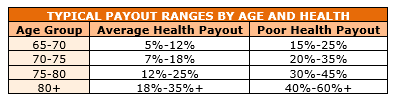
Potential Settlement Amounts – The amount you receive from a life settlement will depend on various factors, including your age, health condition, and the type and size of the policy. Some reports say that the average payout is 10%-35% of the face amount of the policy but they can vary widely. Generally, the older the policyholder or the poorer their health, the higher the settlement offer tends to be, as the buyer of the policy will receive the payout from the death benefit sooner. However, these transactions typically yield a payout that is significantly less than the death benefit of the policy but more than the surrender value.

Disposition of a Policy: Surrender or Sale – When it comes to disposing of a life insurance policy, policyholders have two primary options: surrendering the policy or selling it.

  • Policy Surrender – Surrendering a policy means you’ll cancel the insurance and in exchange the insurance company will pay you the policy’s cash value, net of any redemption fees specified in the contract. If there is no cash value, there is no payment to the policyholder. This option can be straightforward, especially with term policies that typically do not accumulate cash value. However, surrendering a policy could result in tax implications, particularly if your cash surrender value exceeds the total premiums paid.
  • Sale of a Policy – If you opt to sell your policy, particularly if there’s substantial cash value involved, this could prove more financially beneficial than surrendering. When a policy with or without cash value is sold, the policyholder can receive a better return. However, the financial upshot includes intricate tax consequences that aren’t immediately evident.

Tax Implications for Policyholders – IRS taxes life settlement proceeds using a three-tier system.

  • Premiums Paid: Returns up to the amount of the premiums paid generally aren’t taxed.
  • Taxable Gain Ordinary Income: Proceeds up to the policy’s cash surrender value over the amount of premiums paid are taxed as ordinary income.
  • Capital Gains Tax: Amounts that exceed the cash surrender value are subject to capital gains tax.

Example 1 – Surrender of Policy – John held a life insurance policy that accumulated cash value over time. After eight years, he decided to surrender the policy, receiving its cash value of $78,000. This amount included a deduction of $10,000 for the “cost of insurance.” Over the life of the policy, John had paid a total of $64,000 in premiums. Consequently, John realized a gain of $14,000, calculated by subtracting the premiums paid ($64,000) from the cash surrender value ($78,000). Because surrendering a life insurance policy does not yield a capital gain, this $14,000 is considered ordinary income for tax purposes.

Example 2 – Sale of Policy with Cash Value – Consider the same initial scenario, but instead of surrendering the policy, John sells it to George, an unrelated party who has no personal financial stake in John’s death. John receives $80,000 from the sale. This results in a gain of $16,000, calculated by subtracting the premiums he paid ($64,000) from the sale price ($80,000). Of this gain, $14,000—the amount by which the cash value exceeds the premiums paid—is considered ordinary income. The remaining $2,000 is classified as a capital gain.

Viatical Settlements: A Specific Scenario – Any amounts received under a life insurance contract on the life of a terminally ill individual are excluded from tax gross income. Excludable amounts received under a life insurance contract by chronically ill individuals are limited to the cost of qualified long-term care services.

Definitions:
Terminally Ill Individual – the term “terminally ill individual” means a person who has been certified by a physician as having an illness or physical condition that reasonably can be expected to result in death within 24 months of the date of certification.
Chronically Ill Individual – a “chronically ill” individual is one who has been certified within the previous 12 months by a licensed health care practitioner as:

  • (A) being unable to perform, without “substantial assistance” from another individual, at least two activities of daily living for at least 90 days due to a loss of functional capacity,
  • (B) having a similar level of disability as determined under IRS regulations prescribed in consultation with the Dept of Health and Human Services, or
  • (C) requiring “substantial supervision” to protect the individual from threats to health and safety due to “severe cognitive impairment,” even if the individual is physically able.

Information Reporting – All parties involved in life settlement deals must adhere to IRS requirements for information reporting. This includes Form 1099-LS for life settlement transactions and Form 1099-SB for surrendering a policy or being part of a life settlement.

Final Thoughts – Life settlements, viatical settlements, and the broader financial implications they involve are complex. With overlapping rules and potential financial advantages, navigating these waters requires a thorough understanding of not only the transactions themselves but the ever-evolving tax implications they incur. Don’t hesitate to reach out for tailored advice or to discuss your specific situation. Please contact us in our Leesburg (703-771-1818) or Warrenton (540-347-5681) offices if you need further information or assistance.

Potential Tax Benefits From Medically Related Home Improvements

The year 2025 marked a significant milestone in the United States. Why? Because a record number of people reached the age of 65. On average about 11,400 Americans turned 65 every day of the year 2025. This demographic shift, largely driven by the baby boomer generation, has implications for retirement planning, healthcare, and the economy at large.

The U.S. Centers for Disease Control and Prevention (CDC) has stated that falls are the leading cause of injuries among people age 65 and older, and nearly 30% of older adults reported falling at least once in the preceding 12 months. To help minimize falls, and to accommodate age-related infirmities, many people are adding grab bars in showers, modifying stairways, widening hallways to accommodate a wheelchair, and other projects to make the home safer and more accessible for older occupants. If you are planning to make such home improvements, you may be eligible to include the costs as a medical expense for income tax purposes.

Generally, the costs of home improvements are not deductible except to offset home gain when the home is sold. But a medical expense deduction may be claimed when the primary purpose of the home modification is for a medical reason. The tax law says that deductible medical expenses are those paid for the “diagnosis, cure, mitigation, treatment, or prevention of disease, and the costs for treatments affecting any part or function of the body.”

So, if you are making the modifications because you, your spouse, or a dependent has a medical need for doing so, then the modification expense may be deductible as a medical expense, but only to the extent that it exceeds any resulting increase in the home’s value.

Even though a prescription from a doctor for most medically related home modifications isn’t required, the taxpayer, if questioned by the IRS, needs to be able to demonstrate how the expenditure relates to his or her medical care or that of a spouse or dependent. And having a letter from the individual’s doctor that explains the type of modifications that would be medically beneficial would help to prove a medical need.

Not all improvements result in an increased home value. In fact, some, such as lowering cabinets for an occupant confined to a wheelchair, could decrease the home’s resale value.

The IRS has identified certain improvements that don’t usually increase a home’s value but for which the full cost can be included as a medical expense. These improvements include, but are not limited to, the following items:
• Constructing entrance or exit ramps for the home,
• Widening doorways at entrances or exits to the home to create space for walkers and wheelchairs.
• Widening or otherwise modifying hallways and interior doorways,
• Installing railings, support bars, or other modifications,
• Lowering or modifying kitchen cabinets and equipment,
• Moving or modifying electrical outlets and fixtures,
• Installing porch lifts, stairs lifts and other forms of lifts.
• Modifying fire alarms, smoke detectors, and other warning systems,
• Modifying stairways,
• Bathroom modifications including grab bars, lower sinks, and roll-in showers,
• Adding handrails or grab bars anywhere,
• Modifying hardware on doors,
• Modifying areas in front of entrance and exit doorways,
• Grading the ground to provide access to the residence, and
• Flooring modifications, including non-slip surfaces or leveling floors to prevent falls
Only reasonable costs to accommodate a home to a disabled condition or to an elderly individual are considered medical care costs. Additional costs for personal preferences, such as for architectural or aesthetic reasons, are not medical expenses (but could be additions to the home’s tax basis).

Unfortunately, the total of all medical expenses can be deducted only to the extent that they exceed 7.5% of the taxpayer’s adjusted gross income (AGI) and only if the taxpayer itemizes deductions. With the current high value of the standard deductions, fewer than 15% of taxpayers are expected to currently itemize their deductions. So even if a medically needed home improvement is made and qualifies to be deducted, only a small percentage of taxpayers will end up with a tax benefit because of the expenditure.

All is not lost, though. To the extent that the taxpayer doesn’t claim the expense as an itemized deduction, the improvement costs, including those that might not meet the medically necessary standard, can be added to the home’s purchase cost to determine the home’s tax basis. Thus, when the home is sold, the capital gain from the sale will be lower. Either to substantiate the currently deductible improvements or with a future home sale in mind, taxpayers should be sure to keep records of the home improvements they make, including the receipts for the costs. Maintaining “before and after” photos is also recommended.

Hot Tub Deduction Issues: When exploring the realm of medically deductible home improvements, it’s nearly impossible to avoid the intriguing discussions around the attempts to classify home hot tubs as medical expenses. Taxpayers frequently explore innovative strategies to lower their tax obligations, and one common tactic involves claiming a hot tub as a medical expense.

These efforts often sit at the intersection of necessity and luxury, challenging both tax laws and personal morality in the quest to alleviate the burdens of medical costs. Understanding what qualifies as a legitimate medical home modification means delving into the creative strategies employed by taxpayers to include items like hot tubs in their deductible expenses, bringing to light broader questions about health-related tax benefits and individual needs.

While it is indeed feasible to claim a hot tub as a deductible medical expense, the process is intricate and must adhere to stringent IRS guidelines. The primary use of the hot tub must be for medical treatment rather than for general wellness or leisure activities. This presents considerable tax challenges and requires clear documentation to satisfy IRS conditions, emphasizing that the primary function is health-related rather than for enjoyment or relaxation purposes. Here are the critical tax considerations and guidelines

• Primary Use: The fundamental requirement is demonstrating that the hot tub’s main function is for the “diagnosis, cure, mitigation, treatment, or prevention of disease.” Expenses that simply enhance general well-being do not qualify for a deduction.
• Medical Confirmation: A detailed prescription or recommendation from a licensed physician, specifying the medical condition (such as arthritis, chronic back pain, or fibromyalgia) and explaining how hydrotherapy will aid treatment, is crucial for IRS verification. Notes from chiropractors or non-MD practitioners are generally insufficient.
• Capital Expense vs. Property Value Enhancement: The IRS regards a hot tub as a capital expense, akin to a home improvement.
If its installation leads to an increase in property value, only the portion of the cost that surpasses this enhancement is deductible. An appraisal might be necessary to determine the exact increase.
If the hot tub does not elevate the home’s value (for example, a portable unit), the entire expense might be deductible.

Example: A doctor recommends that his patient with severe arthritis have daily hydrotherapy, and so the individual has a hot tub installed at a cost of $21,000. The individual then hires a certified home appraiser to determine how much the hot tub addition increased the home’s value. The appraiser concludes the increase is $20,000. The individual’s medical deduction for the year the hot tub is installed will be limited to $1,000 ($21,000 – $20,000). The other $20,000 of expenses will increase the home’s basis, meaning that it will add to the home’s cost and will offset the sales price when the home is sold.

• Threshold for Deductible Amounts: Medical expenses, including the hot tub, are deductible only if they exceed 7.5% of your Adjusted Gross Income (AGI). Many taxpayers may not surpass this threshold, effectively negating the deduction.
• Apportioning for Personal versus Medical Use: If the hot tub is utilized by other family members or enjoyed for reasons unrelated to the medical condition, only the portion of costs that corresponds to its medical use are deductible.
• Reasonable Cost: The IRS may closely examine the size and expense of the hot tub. A modest, functional spa is easier to justify than a large, luxurious built-in model with a costly customized deck, which might imply a recreational intent.
• Record Keeping and Audits: Thorough documentation is essential. Keep all receipts related to the purchase, installation, and maintenance (such as electricity, chemicals, repairs). In a potential audit, a taxpayer will need to provide medical evidence, the doctor’s prescription, and possibly a usage log to demonstrate its primary medical purpose.


It is also noteworthy to mention these same issues would apply to swimming pools, saunas, elevators and the like.

If you have questions related to this deduction and whether you will benefit, tax-wise, from any medically related home modifications, please contact our Leesburg (703-771-1818) or Warrenton (540-347-5681) offices for further assistance.

Get Ready for the New 1099-DA Cryptocurrency Reporting Requirements

The Purpose and Impact of Form 1099-DA: Form 1099-DA aims to increase tax compliance and improve reporting accuracy in the digital asset space by requiring brokers to report transactions. This standardizes reporting and can simplify tax filing for some investors but also necessitates diligent record-keeping to ensure accurate reporting.

Who Must Issue Form 1099-DA? The reporting obligation for Form 1099-DA falls on “brokers” who facilitate the sale or exchange of digital assets. The IRS’s definition of a broker is broad and includes digital asset trading platforms, payment processors, and hosted wallet providers. However, decentralized finance (DeFi) platforms and non-custodial wallets are not generally required to issue this form.

Who Will Receive Form 1099-DA? U.S. taxpayers who sell, trade, or dispose of digital assets through a qualifying broker should expect to receive a Form 1099-DA in early 2026 (for 2025 transactions). This includes individuals and businesses involved in buying, selling, trading, mining, or staking digital assets. Real estate reporting entities must also report if digital assets are used in real estate transactions.

What Information is Included on Form 1099-DA? Form 1099-DA requires brokers to report detailed information about each digital asset transaction, including:

  • Payer and Recipient Identification.
  • Transaction details like asset name, quantity, date, time, and gross proceeds.
  • Cost basis (mandatory for “covered securities” acquired after January 1, 2026). Broker reporting of basis is voluntary for the 2025 tax year.
  • Holding period.
  • Transaction type.
  • Fair Market Value (FMV).
  • Transaction fees.
  • Wash sales for tokenized securities.

The information reported on Form 1099-DA varies depending on the tax year.

  • 2025 Tax Year (forms sent in early 2026) – For 2025 transactions, brokers are required to report the gross proceeds from the sale, exchange, or other disposition of a digital asset. Reporting of the cost basis is voluntary for brokers in 2025.
  • 2026 Tax Year and beyond (forms sent in early 2027 and later) – Starting with the 2026 tax year, brokers will be required to report more comprehensive information, including gross proceeds, cost basis (for “covered securities”), acquisition and disposition dates, holding period, and transaction details like the type and quantity of the digital asset.

Understanding the Cost Basis Challenge for 2025: A significant point for the 2025 tax year is the voluntary cost basis reporting by brokers. If the cost basis is not reported on Form 1099-DA, the IRS may assume it’s zero, which could lead to tax notices for underreported income. To prevent this, taxpayers must keep detailed personal records of their digital asset transactions, including acquisition dates and costs, fees, disposition dates, and sales proceeds. These records are necessary for accurately completing Forms 8949 and Schedule D.

Special Reporting Rules for Stablecoins and Non-Fungible Token (NFTs): There are specific reporting rules for certain digital asset types.

  • Qualifying Stablecoins – For 2025 and later, brokers can report qualifying stablecoin transactions in aggregate if they exceed $10,000 annually.
  • Specified NFTs – Starting in 2025, if total sales of specified NFTs exceed $600 for the year, brokers must report them, potentially in aggregate.

How Form 1099-DA is Used File Taxes: The information on Form 1099-DA is used when preparing tax returns similar to the way stock transactions reported on Form 1099-B are transferred to Form 8949 and Schedule D. This involves reconciling the 1099-DA with a taxpayer’s records, calculating capital gains or losses, and reporting the final amount on Form 1040.

Best Practices for Crypto Investors: Given these changes, digital asset investors should maintain detailed records of all transactions, consider using crypto tax software for tracking and calculations, and be aware of potential limitations in broker reporting, especially regarding cost basis in 2025. It is also important to remember that transactions not reported on a 1099-DA must still be reported. Staying informed and consulting a tax professional can help navigate this evolving landscape.

Answering the IRS Question about Digital Assets: For the last several years, a “yes”/”no” question on Form 1040 has been: “At any time during [return year], did you: (a) receive (as a reward, award, or payment for property or services); or (b) sell, exchange, or otherwise dispose of a digital asset (or a financial interest in a digital asset)?” Now that brokers will be issuing Form 1099-DA for the sale or exchange of digital assets, the IRS will be able to verify how taxpayers answer the question in light of the Form 1099-DA that was filed by the broker. When signing the tax return, the taxpayer signs under penalty of perjury that the information in the return is true, correct and complete. Care needs to be taken to correctly answer the IRS’ question.

Contact the Leesburg office 703-771-1818 or the Warrenton office 540-347-5681 if you have questions or need assistance with properly including your crypto transactions on your return.

Pension Catch-up Contributions

Individuals age 50 and over can make additional annual “catch-up” contributions to salary reduction plans including 401(k) Deferred Compensation plans, 403(b) TSA plans, 457(b) Government plans and SIMPLE plans.

Age 50+ Catch-ups: For 401(k), 403(b) and 457(b) plans, the age 50 and over catch-up contributions, for plans that offer them, has been $7,500 for years 2023 through 2025 and for SIMPLE plans $3,500. These amounts are periodically adjusted for inflation.

Age 60 through 63 Catch-ups: New for 2025, the SECURE 2.0 ACT introduced an additional catch-up contribution for taxpayers aged 60 through 63. The thought being those are the ages nearing retirement when individuals have more available income that they can contribute to their retirement nest egg.

The SECURE 2.0 Act increases the catch-up contribution limits to the greater of $10,000 or 50% more than the regular catch-up amount, which results in a maximum catch-up for 2025 of $11,250 for those aged 60 through 63.  For SIMPLE plans, the computation is somewhat different and the maximum catch-up for 2025 is $5,250 ($6,350 if there are no more than 25 employees).

Mandatory Roth Contribution for Higher Incomes: Effective January 1, 2026, for employees with wages of more than $145,000 in the prior year from the employer sponsoring the plan, catch-up contributions must be designated as Roth contributions.

  • Inflation-Adjusted: The $145,000 will be inflation-adjusted in future years.
  • Employees Under the Threshold: Other employees who are eligible to make catch-up contributions may designate their catch-up contributions as a Roth contribution.
  • Employer Doesn’t Have a Designated Roth Plan: If the employer doesn’t have a designated Roth plan, then catch-up contributions cannot be made by employees whose wages exceed the Roth catch-up wage threshold.
  • No Prior Year Employment History: An employee who worked for the employer sponsoring the plan for only part of the preceding calendar year would be subject to the Roth catch-up requirement in the current year only if the employee had wages exceeding the full Roth catch-up wage threshold from the employer for the preceding calendar year.

Key Tax Planning Opportunities: Taxpayers can leverage this amendment as a strategic way to broaden their tax planning approaches. By contributing to Roth accounts, retirees have the advantage of reducing the risks linked to fluctuating future tax rates, as they can access funds from both taxed and untaxed accounts. Roth accounts provide the benefit of tax-exempt withdrawals of both the initial contributions and the investment gains, provided specific conditions, such as the employee being age 59½ and the five-year rule, are met. This capability enhances the appeal of Roth plans as a powerful instrument for estate planning, as they do not require distributions during the original owner’s lifetime.

  • Explanation of the Five-Year Rule: A distribution will not be a qualified distribution if the distribution is made between the time of the first contribution to the plan and before five consecutive taxable years have been completed. Generally, the holding period is determined separately for each plan in which the employee participates. So, if an employee has elective deferrals made to Roth 401(k)s under two or more plans, the employee may have two or more different holding periods, depending on when the employee first had made contributions to a Roth 401(k) under each plan. Special rules apply when there have been rollovers of Roth plans. Check with this office for additional details.

Timing Considerations: Taxpayers should plan the timing of their Roth contributions wisely. Younger high-income employees could benefit from starting Roth contributions now to meet the five-year holding period before retirement, whereas those nearing retirement might need alternative strategies.

If you have questions or need assistance, please contact the Leesburg office 703-771-1818 or the Warrenton office 540-347-5681.

How to Benefit From Qualified Charitable Distributions (QCDs)

Qualified Charitable Distributions (QCDs) are a highly effective tool in the tax planning toolkit, particularly for retirees who must take Required Minimum Distributions (RMDs) from their Individual Retirement Accounts (IRAs). By directing a portion or all of an RMD directly to a charity, taxpayers can potentially reduce their taxable income significantly, yielding multiple tax advantages.

Understanding QCDs

A QCD is a transfer of funds from an individual’s IRA, payable directly to a qualified charity. These distributions can be counted toward satisfying your RMD for the year, up to an inflation adjusted maximum amount. QCDs were first introduced as a temporary provision in 2006, but since then have become a permanent feature of the tax code.

How QCDs Work

For a distribution to be considered a QCD, it must meet specific criteria:

  • Eligible Accounts: The funds must come from a traditional IRA, and the account holder must be at least 70½ years old at the time of the donation. Distributions cannot be from SEP or SIMPLE IRAs. The QCD can come from a Roth IRA only if it is a non-taxable distribution.
  • Direct Transfer Requirement: The funds must be transferred directly from the IRA custodian to the qualified charity.
  • Qualified Charitable Organization: The recipient must be a 501(c)(3) organization, and the donor is responsible for obtaining an acknowledgment letter from the organization under the same documentation rules as if claiming an itemized deduction for a charitable donation. Generally, private foundations, donor-advised funds, or supporting organizations do not qualify. However, the SECURE 2.0 Act allows a one-time $50,000 distribution to certain charitable structures, including charitable gift annuities, charitable remainder unitrusts, and charitable remainder annuity trusts. The $50,000 maximum lifetime distribution amount is adjusted for inflation, and for 2025 is $54,000.

Tax Benefits of QCDs

  • Income Reduction: Since a QCD is not taxable, it does not increase the Adjusted Gross Income (AGI). This characteristic can be beneficial in several ways beyond just avoiding income taxes on the RMD.
  • Enhancing Income-Limited Tax Benefits: wer AGI means potentially enhanced eligibility for other tax benefits and credits that are income-limited. Here are a few examples:
    • Social Security Taxation: By not increasing your AGI, QCDs can help maintain lower-taxed tiers of Social Security benefits.
    • Medicare Premiums: Medicare Part B and Part D premiums are determined by AGI. By keeping this figure low through QCDs, you can avoid higher Medicare premiums.
    • Itemized Deductions Threshold: A lower AGI level can help with thresholds that apply to itemized deductions, thereby increasing their value.
  • Same Benefit as Charitable Contributions, Plus More: Normally, when a taxpayer makes a charitable contribution and itemizes deductions, that amount reduces taxable income. However, a QCD provides the same benefit of a charitable deduction without having to itemize, while also lowering the AGI. This is an advantage for taxpayers who take the standard deduction.

Not Just for High-Income Taxpayers

There’s a common misconception that QCDs primarily benefit high-income taxpayers because of the significant annual limit, which is $108,000 in 2025 due to inflation adjustments from the original $100,000 maximum. However, QCDs can be utilized by any eligible taxpayer meeting the age requirement to lower their taxable income and improve their tax situation. Even small donations can leverage the benefits associated with reduced AGI targets. For a married couple, the annual limit applies to each spouse who has an IRA.

The IRA Contribution Trap

While QCDs can be incredibly beneficial, it’s essential to be aware of the so-called “IRA Contribution Trap.” This issue arises because the Internal Revenue Service (IRS) treats any deductible IRA contributions made after age 70½ as a reduction in the allowable QCD amount. For instance:

  • If you contribute $6,000 to your IRA after age 70½, and simultaneously, you intend to make a $10,000 QCD, only $4,000 of that QCD will qualify for the exclusion. This rule reduces the intended tax benefit of the QCD.

Understanding this catch is crucial for retirees who are still working and might continue contributing to their IRAs while also planning to make QCDs.

Strategic Considerations

Taxpayers should consider the timing and structure of QCDs, especially in years where they may face other significant income events. Planning your QCDs in conjunction with other taxable events can help maintain lower AGI levels, thus optimizing the overall financial benefits.

For example, if a taxpayer anticipates a substantial capital gain or receives a large payment from another source, a well-timed QCD can offset the income increase, helping to manage the AGI.

Conclusion

Qualified Charitable Distributions are not merely a tool for philanthropic endeavors; they are a powerful strategy for managing taxable income and maintaining eligibility for other tax-related benefits. By understanding how QCDs work, taxpayers can strategically plan their charitable giving while maximizing their tax advantages.

In summary, QCDs offer multi-faceted benefits, including income reduction, enhancement of other tax benefits, and a simplified way to execute charitable giving. Whether you are making small donations or using the full annual limit, incorporating QCDs into your tax strategy can have far-reaching results that benefit your finances and the organizations you choose to support.

If you are retired and planning a significant contribution to your place of worship or another charitable organization, such as a donation to your faith community’s building fund, it would be prudent to explore the option of a Qualified Charitable Distribution (QCD). Please contact our Leesburg (703-771-1818) or Warrenton (540-347-5681) office for personalized assistance in evaluating how a QCD might benefit your specific situation.